

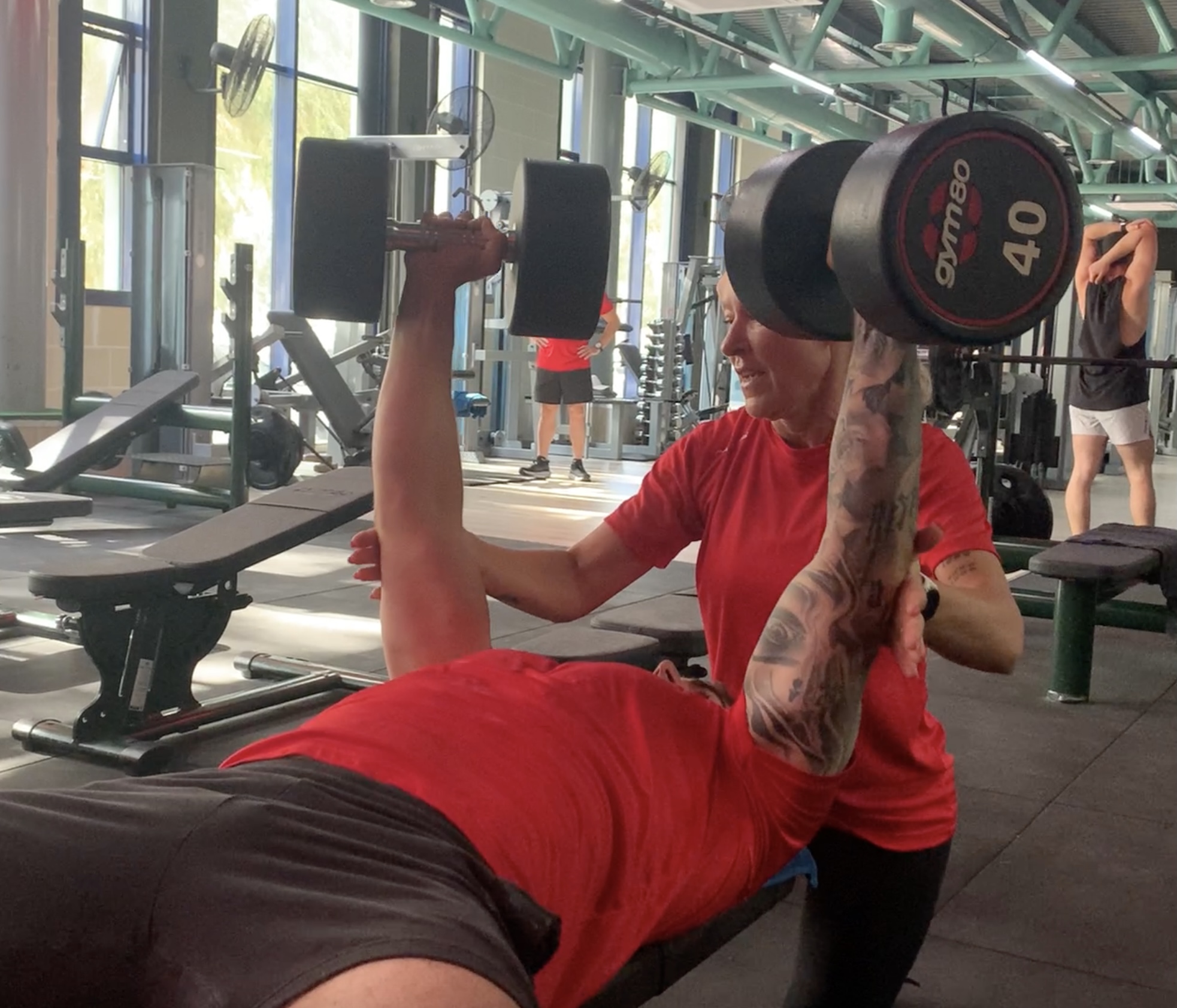
Am I too old to become a personal trainer?
No, and the people who ask are usually better placed to succeed than they think.
It is the question we are asked most quietly, usually at the end of a phone call and often with an apology attached. So here is the long answer: who actually trains with us, what you bring that a twenty-two-year-old does not, the two things that genuinely are harder, and what the course asks of you physically.
The short answer
There is no upper age limit on any of our courses, and no entry requirements at all. We have trained students from their late teens to their sixties, and we have never once had a conversation afterwards about somebody having been too old for it.
What we do see, repeatedly, is people in their forties and fifties arriving nervous and leaving as some of the most capable coaches in the group. That is not encouragement. It is a pattern, and the rest of this piece is about why it happens.
It is worth separating the two worries that usually sit behind the question, because they have different answers:
- Will anyone hire me, or will clients want somebody younger? This one is mostly the opposite of what people fear, and the next two sections explain why.
- Am I physically up to it? A fair question, with an honest answer further down.
There is a third worry that people rarely say out loud, and Gemma Caruana put it better than we could. She was 55 when she took the Master PT Diploma at our Ta' Qali campus in May 2024.
"I was mainly worried that everybody would be looking at me and saying, what's she doing here? But actually, I fit right into place."
That is the one we hear most often once people relax enough to admit it, and it is the one that dissolves fastest. Practical groups are mixed in age, everyone arrives nervous, and by the second morning nobody is thinking about it.
What you bring that a twenty-two-year-old does not
Personal training is often described as a young person's industry. In terms of who signs up for courses, that is broadly true. In terms of who makes a living from it, it is much less true, because most of what separates a busy trainer from a quiet one has nothing to do with age.
You know how to talk to people. The hardest part of the job is not programming. It is the consultation, the awkward conversation about why somebody has not turned up for three weeks, and the judgement to know when to push and when to listen. Twenty years of working life teaches that in a way no course can.
You have probably run something. Self-employed trainers are running a small business: pricing, invoicing, marketing, keeping records, chasing payment. Career changers often arrive with those skills already, while a younger trainer is learning them at the same time as learning to coach.
You are credible to the people most likely to hire you. More on this below, but a client in their fifties who has not exercised since school is making a nervous decision. Being coached by someone who looks like they understand that matters more than most people expect.
You are more likely to stay. People who change career deliberately, having thought about it and often taken a pay cut to do it, tend to be the ones still training clients three years later.
Keith Hendren was 62 and a retired purchasing director from Zurich when he took the Master PT Diploma in October 2016. In his words: "I wanted to understand the role of PT and how it could be used to start a business."
The clients who want a trainer like you
Here is the part most people have not considered. The fastest-growing group of clients in the industry is people your own age and older.
Each year the American College of Sports Medicine surveys around 2,000 fitness professionals worldwide on the trends shaping the industry. For 2026, fitness programmes for older adults ranked second out of the whole list, behind only wearable technology (McAvoy et al., 2025). It has been climbing for years and shows no sign of stopping.
Those clients are not looking for a twenty-two-year-old who has never had a bad back. They want somebody who takes their knees seriously, who does not assume they can get up off the floor easily, and who has some idea what a working life does to a body. Plenty of them say so directly when choosing a trainer.
The same applies to several other groups worth building a business around: people returning to exercise after a long gap, parents fitting training around young children, people managing a long-term health condition alongside a GP. In each case, life experience reads as competence rather than as a gap on your CV.
None of this means you should only train older clients. It means that the part of the market growing fastest is the part where your age is an asset, and that is a reasonable place to start a career.
What the research says about strength and ageing
This matters twice over: for the clients you will train, and for your own confidence about doing the job.
The National Strength and Conditioning Association's position statement on resistance training for older adults is the clearest summary available. Reviewing the evidence, it concludes that countering muscle disuse through resistance training is a powerful intervention against age-related losses in muscle strength and mass, and that the benefits reach well beyond muscle: better physical function, mobility and independence, better management of chronic disease, and improved psychological wellbeing and quality of life (Fragala et al., 2019).
It also makes a point that is easy to miss. One of the statement's stated goals is reducing the fears and barriers that stop older adults starting a programme in the first place. Those barriers are largely about confidence, and confidence is built by the person doing the coaching rather than by the programme itself.
For you, the practical conclusion is straightforward. Strength and function are trainable at any age, including yours. The job asks you to demonstrate exercises competently and coach them clearly. It does not ask you to be the strongest person in the room, and a trainer who has built their own fitness in their forties often explains the process better than one who has never had to.
Two things that genuinely are harder
We would rather say this plainly than have you discover it later.
The physical day. Personal training means long hours on your feet, demonstrating movements, loading plates and often working early mornings and evenings with a gap in the middle. That is tiring at any age and it is more tiring at fifty-five than at twenty-five. It is manageable, and plenty of our graduates manage it, but it needs planning: your own training and recovery become part of the job rather than something you fit around it. Trainers who ignore that do not last, whatever age they start.
Studying again after a long gap. If you have not written an assignment since school, the first one is uncomfortable. Not because the material is difficult, but because the habit has gone. It comes back faster than people expect, usually within two or three assignments, and it is the single most common thing students tell us they worried about unnecessarily.
Gemma again, on exactly this: "At first I was overwhelmed with everything, because I haven't studied for so long. But I was able to follow the videos and get on with the coursework as easy as ABC. The tutors were absolutely fabulous."
What is not harder, in our experience: learning to coach, being taken seriously by clients, finding work, or keeping up on the practical course.
What the course actually asks of you
If the worry is whether you could physically and practically get through it, here is what is involved.
No entry requirements. No previous qualifications, no industry experience, no upper age limit.
The online study is self-paced. Most students allow 12 to 16 weeks at around 10 to 15 hours a week, and fit it around a job. You have your own tutor from the day you enrol, who marks your assignments with written feedback and will set up a video call if you get stuck with anything, including the technology.
The practical course is two weeks on campus, 9am to 5pm, in a small group. You will be on your feet and demonstrating exercises, but you are being assessed on coaching rather than on performance. You need to demonstrate movements safely and explain them clearly. You do not need to lift anything impressive.
The exams are multiple choice and take place during the practical course, after you have revised with tutors on hand.
If you want to know how the two weeks actually feel before committing, our student video testimonials are the best guide. There are over 600 of them, recorded since 2014, and they include plenty of people who arrived with exactly the worry that brought you to this page.
If this is the only thing stopping you
Most people who ask about age have already decided they want to do it. The question is really a request for permission.
So: you do not need it, and nobody is going to tell you that you are too old, because you are not.
If you would like a straight answer about your own situation, email Toby at
Otherwise, you can see our upcoming practical course dates or start an application, which takes about five minutes, involves no payment and commits you to nothing.
